About the project
Explore our interactive network diagrams to unveil the intricate connections between China’s propaganda system and associated companies.
We’ve mapped the data focused on four key thematic areas, from direct ties to state ownership to more indirect connections facilitated by substantial state support. Scroll down to delve deeper into our methodology and access a glossary of terms for comprehensive understanding.
For more, download our accompanying report ‘Truth and reality with Chinese characteristics: The building blocks of the propaganda system enabling CCP information campaigns’.
Introduction
The Chinese Communist Party (CCP) is leveraging its propaganda system to build a toolkit to enable information campaigns. Its objective is to control communication and shape narratives and perceptions about China in order to present a specific version of truth and reality, both domestically and internationally. Ultimately, the CCP aims to strengthen its grip on power, legitimise its activities and bolster China’s cultural, technological, economic and military influence.
The CCP seeks to maintain total control over the information environment within China, while simultaneously working to extend its influence abroad to reshape the global information ecosystem. That includes not only controlling media and communications platforms, but also ensuring that Chinese technologies and companies become the foundational layer for the future of information and data exchange worldwide.
Our research has found that the CCP seeks to harvest data from various sources, including commercial entities, to gain insights into target audiences for its information campaigns. We define an information campaign as a targeted, organised plan of related and integrated information operations, employing information-related capabilities (tools, techniques or activities) with other lines of operation to influence, disrupt, corrupt or manipulate information – including the individual or collective decision making based on that information – and deliberately disseminated on a large scale. The party also invests in emerging technologies such as artificial intelligence and immersive technologies that shape how people perceive reality and engage with information. The aim is to gain greater control, if not dominance, over the global information ecosystem.
To understand the drivers, tools and outcomes of that process, we’ve examined the activities of the People’s Republic of China in the information domain, particularly its investments in technology and research and development (R&D) companies that might serve as ‘building blocks’ for the CCP’s information campaigns.
Methodology
The CCP’s propaganda efforts on social media have been widely studied, developing a baseline understanding of common narratives and tactics. Previous ASPI research, for example, has tracked a persistent, large-scale influence campaign linked to Chinese state actors on Twitter and Facebook. Several other research institutes have published important research on how the Chinese party-state attempts to control the information environment globally.
China’s propaganda system is a vast structure in and of itself. Under its direct control or with its direct support are a web of additional entities whose portfolio contributes to the party’s ability to meet its strategic aims in the information environment. Countries that understand the ‘invisible architecture’ of the CCP’s propaganda system and technologies will be better able to address and respond to its global efforts to skew the information environment.
Important research questions remain under-studied. In particular, there is limited research on the precursors to those information campaigns: that is, the building blocks that need to be in place to support and inform successful efforts to shape the information environment. What is the Chinese party-state doing to build its capacity to control ‘truth’ and influence how external audiences perceive, engage with and question reality?
In order to bridge this knowledge gap, this project examines how the party-state is leveraging the propaganda system:
- Through commercial entities, collecting data or gaining access to datasets it deems strategically valuable that could be used for propaganda purposes, including potentially for current or future information operations. For example, data collection activities that build the party-state’s capacity to generate insights on current or potential information operations targets.
- Through state support, investing in R&D and access to new and emerging technology to shape or distort the information environment both domestically and globally.
Our project is based on ASPI’s 2019 report Engineering Global Consent. That report first identified Global Tone Communications Technology (GTCOM), a machine-translation company which is controlled by the CCP Central Propaganda Department. GTCOM claims that it accesses data from social media and downstream access to datasets of the IoT and software products it supplies, mainly to other PRC technology companies, to generate insights to support China’s state security and propaganda work.
Building on Engineering Global Consent, we have sought to identify and explain how the Chinese party-state’s expansive propaganda system exploits new and emerging technologies and seeks to shape or distort the information environment both domestically and globally. To answer these questions, we generated network graphs describing the relationships between companies in our dataset, which are mostly Chinese state-owned or backed by state funds, with direct links to the propaganda system and other entities. We used this research to better understand areas of business activity associated with the PRC’s propaganda system, especially when such behaviour was related to data collection, aggregation and processing activities.
Our research effort involved identifying entities linked to the Propaganda Department of the Chinese Communist Party’s Central Committee (‘the Central Propaganda Department’), provincial-level propaganda departments, or other party-state bodies linked to the propaganda system, such as the Ministry of Culture and Tourism. This project began with a months-long effort to build a network graph of companies that were directly and indirectly linked to the Propaganda Department. Our research included looking for subsidiaries, shareholders, and strategic cooperation and MoU partners of the companies we identified. Our information sources focused on PRC-based company databases and shareholders, and included company websites, company press releases, and corporate disclosure documents. We then narrowed the scope of our research to focus on the specific case studies covered in this report.
Party-state news and publishing outlets were included in our research, because the Central Propaganda Department is responsible for supervision of news and publishing work, and these outlets are key information dissemination platforms. However, rather than simply mapping out the names of media and publishing outlets, and their publication outputs domestically in China and overseas, our research emphasis was on identifying where those outlets are establishing branches or partnerships that expand their business activity into areas of business related to new and emerging technology.
Companies were included in our research scope if they were locally or centrally state-owned enterprises with direct ties to China’s propaganda system, and especially directly to the Central Propaganda Department. These could be through corporate structures, such as relationships to the Propaganda Department-managed China Publishing Group and its subsidiaries, or political entities whose activities are explicitly supervised and constrained by the Propaganda Department.
More enterprises were located through research on cultural enterprises and cultural exports. Companies that appeared on the 2022-2023, and often also the previous 2021-2022 National Key Cultural Export enterprise and project lists (most current of a regular list), were all included in the scope of research. The National Key Cultural Export list includes companies that are chosen by the Propaganda Department, Commerce Ministry, Finance Ministry, and Culture and Tourism Ministry. Private enterprises on the list are explicitly given preferential treatment, such as tax incentives, that gives them the same benefits of state-owned cultural enterprises.
This website provides a subset of the data we collected. Network graphs illustrate the relationships between a subset of the entities we located and the Central Propaganda Department. Our effort to map out these entities was used as background research informing our analysis. From this list, we determined thematic areas where entities of specific types or entities that engage in specific activities were frequently appearing in the dataset. For each case study we chose, activities in the relevant fields could be clearly mapped to specific strategic objectives driven by the Propaganda Department or related to its work. We were particularly interested in PRC state-owned and nominally private entities linked to the PRC’s propaganda system, whose activities resulted in the exploitation or use of new and emerging technologies. The entities selected for the website are linked to the five case studies in this report. This is also the source for the static images in this report.
For full details of the methodology, including all endnotes, please read our report.
Authors
Dr Samantha Hoffman, Tilla Hoja, Yvonne Lau, and Lilly Min-Chen Lee
Acknowledgements
ASPI acknowledges the Ngunnawal and Ngambri peoples, who are the traditional owners and custodians of the land upon which this work was prepared, and their continuing connection to land, waters and community. We pay our respects to their cultures, country and elders past, present and emerging.
In addition to the authors listed above, ASPI acknowledges and thanks the many staff who have worked on this project including Daria Impiombato, Fergus Ryan, Dr Alexandra Caples, Marc Ablong and Danielle Cave. ASPI also thanks peer reviewers Charles Parton, Nadège Rolland, Kenton Thibaut, anonymous external reviewers, and researcher Cheryl Yu.
The project was produced by researchers at the Australian Strategic Policy Institute. Funding was provided by the US State Department.
Copyright
© The Australian Strategic Policy Institute Limited 2023.
This publication is subject to copyright. Except as permitted under the Copyright Act 1968, no part of it may in any form or by any means (electronic, mechanical, microcopying, photocopying, recording or otherwise) be reproduced, stored in a retrieval system or transmitted without prior written permission. Enquiries should be addressed to the publishers. Notwithstanding the above, educational institutions (including schools, independent colleges, universities and TAFEs) are granted permission to make copies of copyrighted works strictly for educational purposes without explicit permission from ASPI and free of charge.
How to cite this project
Report:
Samantha Hoffman, Yvonne Lau and Tilla Hoja and Lilly Min-Chen Lee, ‘Truth and reality with Chinese characteristics: The building blocks of the propaganda system enabling CCP information campaigns’, Australian Strategic Policy Institute, November 2023, aspi.org.au/report/truth-and-reality-chinese-characteristics.
Website:
Dr Samantha Hoffman, Tilla Hoja, Yvonne Lau and Lilly Min-Chen Lee, Identifying the building blocks of China’s information campaigns, Australian Strategic Policy Institute, November 2023, ChinaInfoBlocks.aspi.org.au.
Glossary
Explore the below guide on key entities, relationships and terminology described in this website and in the accompanying report.
Table 1: China’s Propaganda System
China’s propaganda system is vast. Rather than sitting under a single authority, multiple party-state agencies share responsibility for propaganda work. Central leading agencies oversee policy formulation and guidance. Subordinate agencies are responsible for implementing and adapting these policies accordingly.
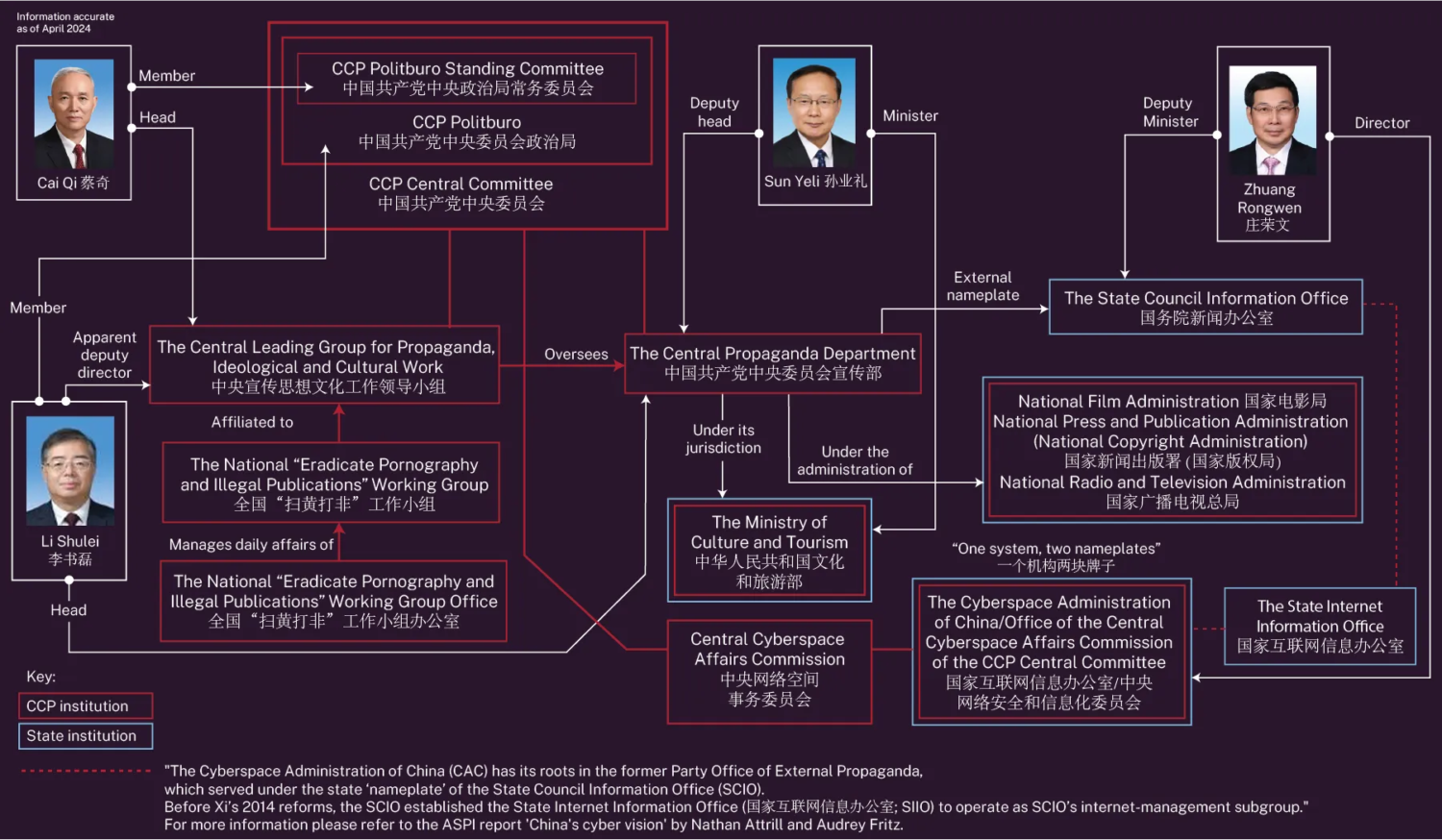
Key central organs responsible for propaganda work.
Standing Committee of the Political Bureau of the CCP Central Committee (中国共产党中央政治局常务委员会) or Politburo Standing Committee) and CCP Central Committee (中国共产党中央委员会)
Standing Committee of the Political Bureau of the CCP Central Committee (中国共产党中央政治局常务委员会) or Politburo Standing Committee) and CCP Central Committee (中国共产党中央委员会)
The Politburo Standing Committee is made up of the CCP’s most senior officials. The current 20th Politburo Standing Committee includes General Secretary Xi Jinping and six other standing committee members. The wider CCP Central Committee consists of numerous functional departments, which include the Central Propaganda Department (see below). Additionally, the Central Committee manages several publications. The People’s Daily (人民日报) is the official mouthpiece of the CCP Central Committee and the largest party-affiliated newspaper in China. It is a public institution directly subordinate to the CCP Central Committee (党中央直属事业单位). Other publications directly subordinate to the CCP Central Committee are Qiushi Journal, Guangming Daily and Economic Daily. Xi Jinping, as general secretary, issues high-level guidance on propaganda work, and policy formulation and implementation are overseen by those with direct responsibility below him. As of early 2024, the official most immediately responsible for propaganda work is Cai Qi. The administrative agency of the Politburo and Politburo Standing Committee is the Secretariat of the Chinese Communist Party, and Cai Qi is the current first secretary of the Secretariat. Cai is also the current head of the Central Leading Group for Propaganda, Ideological and Cultural Work, and Director of the General Office of the Central Committee (‘Xi Jinping’s Chief of Staff’).
Central Leading Group for Propaganda, Ideological and Cultural Work (中央宣传思想文化工作领导小组)
Central Leading Group for Propaganda, Ideological and Cultural Work (中央宣传思想文化工作领导小组)
The Central Leading Group for Propaganda, Ideological and Cultural Work is the highest-level group responsible for interpreting the Party core’s (i.e. Xi Jinping’s) directives on propaganda work, and teaching and propagating those official interpretations to responsible authorities across the party-state apparatus, down to the grassroots level of government. As such, it plays a coordinating role for propaganda work across other party-state agencies with propaganda responsibilities. The leading group was established in 1988 by the Party Central Committee. Its main tasks are to analyse trends in the ideological field; study and master the guidelines, policies and overall issues of propaganda work; coordinate propaganda publications, and provide opinions and suggestions on propaganda work. The leading group is directly responsible for overseeing the work of the Central Propaganda Department. In addition to Cai Qi, the current head of the leading group, Li Shulei, who is head of the Central Propaganda Department, is an apparent deputy director (a title not clearly identified, but suggested because the Propaganda Department head typically chairs meetings of the leading group). Propaganda departments across provincial and sub-provincial-level party committees are ultimately under the control of the Central Propaganda Department, which also approves the appointment of propaganda department leadership personnel in provinces, autonomous regions and municipalities. Under these collective agencies are a large number of not just state-run media outlets, but also state-owned enterprises engaged in business across different aspects of the media and publishing industries.
The National “Eradicate Pornography and Illegal Publications” Working Group (全国“扫黄打非”工作小组) and its daily affairs office the National “Eradicate Pornography and Illegal Publications” Working Group Office (全国“扫黄打非”工作小组办公室)
The National “Eradicate Pornography and Illegal Publications” Working Group (全国“扫黄打非”工作小组) and its daily affairs office the National “Eradicate Pornography and Illegal Publications” Working Group Office (全国“扫黄打非”工作小组办公室)
The working group is directly affiliated to the Central Leading Group for Propaganda, Ideological and Cultural Work. Its membership is drawn from the following 26 departments:
The Central Propaganda Department, the Central United Front Work Department, Central Political and Legal Affairs Commission, the Cyberspace Administration of China (Office of the Central Cyberspace Affairs Commission of the CCP Central Committee), the Taiwan Work Office of the CCP Central Committee, General Office of the State Council, Supreme People’s Court, the Supreme People’s Procuratorate, Ministry of Education, Ministry of Industry and Information Technology, Ministry of Public Security, Ministry of State Security, Ministry of Civil Affairs, Ministry of Finance, Ministry of Housing and Urban-Rural Development, Ministry of Transport, Ministry of Culture and Tourism of the People’s Republic of China, General Administration of Customs of the People’s Republic of China, State Administration for Market Regulation, National Radio and Television Administration, National Copyright Administration, Civil Aviation Administration of China, State Post Bureau, Beijing Municipal Committee of the Communist Party of China, Political Work Department of the Central Military Commission, and China State Railway Group Co., Ltd.
The head of the Central Propaganda Department is the head of the working group.
Central Propaganda Department (中国共产党中央委员会宣传部)
Central Propaganda Department (中国共产党中央委员会宣传部)
The Central Propaganda Department (CPD) is one of several functionary departments of the CCP Central Committee. In the simplest terms, the CPD is responsible for public opinion guidance and oversight of the planning and deployment of the CCP’s ideological and theoretical work, both internal and external to China. The CPD is responsible for supervision of news and publishing work. Along with the Central Organization Department, another department of the CCP Central Committee, it oversees the personnel and publication of key Central Committee-controlled publications including the People’s Daily. Li Shulei, a member of the CCP Central Committee, is the current head of the CPD, and simultaneously also a member of the Secretariat of the CCP. Also Under 2018 State Council reforms, responsibilities of the General Administration of Press, Publications, Radio, Film and Television were transferred to the CPD. The department now administers the following state institutions: National Film Administration (国家电影局); National News and Publishing Administration (National Copyright Office) (国家新闻出版署 (国家版权局)); and National Radio and Television Administration (国家广播电视总局).
Ministry of Culture and Tourism (中华人民共和国文化和旅游部)
Ministry of Culture and Tourism (中华人民共和国文化和旅游部)
Under 2018 reforms, the ministry was moved directly under the Propaganda Department’s jurisdiction. The deputy head of the CPD also serves as the Minister of Culture and Tourism, and since late 2023, that individual is Sun Yeli (孙业礼). According to a readout from the “two sessions” in 2018, the main responsibility of the ministry is to implement the CCP’s guidance and policies in promoting culture. It studies and formulates culture and tourism policies as well as measures to develop the tourism industry and strengthen international exchanges to promote Chinese culture.
Cyberspace Administration of China (国 家互联网信息办公室) also called Office of the Central Cyberspace Affairs Commission of the CCP Central Committee/State Internet Information Office) (中央网络安全和信息化委员会办公室中华人民共和国国家互联网信息办公室)
Cyberspace Administration of China (国 家互联网信息办公室) also called Office of the Central Cyberspace Affairs Commission of the CCP Central Committee/State Internet Information Office) (中央网络安全和信息化委员会办公室中华人民共和国国家互联网信息办公室)
The Cyberspace Administration of China (CAC) is tied to the Central Propaganda Department both organisationally and through its mandate. As a previous ASPI paper, China’s cyber vision explained: “the CAC has its roots in the former Party Office of External Propaganda, which served under the state ‘nameplate’ of the State Council Information Office (SCIO).
“Before Xi’s 2014 reforms, the SCIO established the State Internet Information Office (国家互联网信息办公室; SIIO) to operate as SCIO’s internet-management subgroup. Following the 2014 reforms, however, the Party Office of External Propaganda was absorbed by the CCP’s Central Propaganda Department. The SIIO, previously subordinate to the SCIO, became host to the Party Office of the new Central Cybersecurity and Informatisation Leading Small Group (中央网络安全和信息化领导小组, later upgraded to the Central Cyberspace Affairs Commission). The office of this leading group established within the SIIO gained a new English name: the Cyberspace Administration of China.”
The CAC implements the guidelines and policies for disseminating information online and promotes the legal system, according to the State Council Information Office. It “constructs, guides, coordinates, and supervises relevant departments in strengthening the supervision of online information”.
State Council Information Office (国务院新闻办公室)
State Council Information Office (国务院新闻办公室)
The State Council Information Office is the nameplate for external propaganda work. The Information Office describes its main responsibilities on its website as to “propel domestic media further along the path of introducing China to the international community”. It also holds press conferences on major Chinese policies and publishes material to promote China internationally. As of late 2023, the Minister for the office is Sun Yeli, who is also the deputy head of the CPD and serves as the Minister of Culture and Tourism.
Central Compilation and Translation Bureau (中央编译局)
Central Compilation and Translation Bureau (中央编译局)
Under 2018 State Council reforms, responsibilities of the General Administration of Press, Publications, Radio, Film and Television were transferred to the Central Propaganda Department (CPD). The CPD, when exercising functions of film administration, is externally known as the National Film Administration (国家电影局).
National Press and Publication Administration (National Copyright Administration) 国家新闻出版署 (国家版权局)
National Press and Publication Administration (National Copyright Administration) 国家新闻出版署 (国家版权局)
The National Copyright Administration was set up in 1985 by the State Council, which then established the Press and Publication Administration in 1987 to join the first.
“In 2001, the Press and Publication Administration (National Copyright Administration) was upgraded as a ministry, and its title was changed to the General Administration of the Press and Publication (National Copyright Administration of China).”
As of the 2018 reforms, what is now known as the National Press and Publication Administration (National Copyright Administration) was incorporated into the Central Propaganda Department, as the brand name for all of the CPD’s press and publication management responsibilities.
National Radio and Television Administration (广电总局, 国家广播电视总局; NRTA)
National Radio and Television Administration (广电总局, 国家广播电视总局; NRTA)
The National Radio and Television Administration (NRTA) is a ministry-level agency directly under the Central Propaganda Department (CPD). Established in 2018 under 2018 State Council reforms, the NRTA holds authority over state-owned television and radio enterprises. It functions as an executive agency within the CCP’s framework, tasked with overseeing state-run enterprises in film and broadcasting.
Terms & Concepts
National Key Cultural Export Enterprise and Project lists
National Key Cultural Export Enterprise and Project lists
The National Key Cultural Export list includes companies that are chosen by the Propaganda Department, Commerce Ministry, Finance Ministry, and Culture and Tourism Ministry. Private enterprises on the list are explicitly given preferential treatment, such as tax incentives, that gives them the same benefits as state-owned cultural enterprises.
Artificial Intelligence
Artificial Intelligence
The ability for a machine to perform functions simulating cognitive processes that approximate human intelligence.
Augmented Reality
Augmented Reality
Digital content overlaying with a users’ physical world view to create a blended visual experience. The mobile game Pokéman GO is an example of the application of augmented reality, where it shows a user’s actual surroundings with new digital information in it.
Cloud Gaming
Cloud Gaming
An online gaming service that allows users to play games on remote servers and stream the content to their device, contrasting with traditional gaming where the game is run on the user’s game console or device. Cloud gaming services are usually subscription-based and users can access games offered by the provider.
Data Exchange Centre
Data Exchange Centre
A location that facilitates the trading of information between different people, systems, and entities for data sharing and collaboration.
Generative Artificial Intelligence
Generative Artificial Intelligence
An artificial intelligence system that learns the patterns and structures of input training data and generate new data with similar characteristics. The generated information can be text, images, and other media forms.
Extended Reality
Extended Reality
An umbrella term for augmented reality, virtual reality, mixed reality, and other forms of experiences that combine or mirror the physical with a digital world.
Information Operations, Information Warfare or Influence Operations
Information Operations, Information Warfare or Influence Operations
Terms that refer to the use of information related capabilities – along a deceptive and subversive spectrum – to gather information about and shape an information environment to either influence or disrupt the decision-making of real or potential adversaries.
Immersive Technologies
Immersive Technologies
Refers to the group of technologies across virtual reality, augmented reality and extended (or mixed) reality.
Large Language Model (LLM)
Large Language Model (LLM)
A model that can perform natural language processing tasks, including the recognition, translation, prediction and generation of texts, after undergoing training using massive text datasets. The quality of LLMs is dependent on the quality of the training data.
Machine Learning
Machine Learning
A field of artificial intelligence that uses algorithms to learn from data and make decisions based on pattern recognition with improved accuracy.
Mixed Reality
Mixed Reality
The overlaying and integration of digital information on the physical world. Unlike augmented reality, the information in mixed reality is anchored to an actual location and changes depending on the user’s perspective. An example of the application is Snapchat filters which allow users to interact with virtual objects as the camera moves around.
Metaverse
Metaverse
A network of 3D virtual worlds featuring real-time interaction, user agency, and elements of immersion. Some platforms require the assistance of virtual reality or augmented reality headsets to access and interact with the virtual worlds. The metaverse may offer a new ‘world’ for social and economic connections.
Natural Language Processing
Natural Language Processing
Refers to a branch of artificial intelligence that gives computers the ability to recognise and process text and spoken words, and understand its full meaning including its intent and sentiment.
Virtual Reality
Virtual Reality
A 3D simulation of an environment that users can explore interactively. Simple VR environments are accessed on personal computers, and keyboard commands are used to navigate a 3D space. More sophisticated VR technology includes wearables, such as VR headsets worn over a to simulate a users’ presence in the 3D space. It is used more widely in applications such as gaming.
References
- Jun Mai, ‘Xi Jinping’s inner circle is getting ‘even tighter’ with powerful new chief of staff’, South China Morning Post, 4 April 2023, online.
- Leading Small Groups are ad hoc bodies of the CCP charged with decision-making on specific policy areas, bringing together senior party officials to set direction and resolve issues. See: Alice Miller, ‘The CCP Central Committee’s Leading Small Groups’, China Leadership Monitor, No. 26, online.
- ‘Xi Jinping issued important instructions on the work of propaganda of ideology and culture’ [习近平对宣传思想文化工作作出重要指示], Xinhua Net, 8 October 2023, online. Previously the “Central Propaganda and Ideological Work Leading Small Group” (中央宣传思想工作 领导小组).
- ‘About us’ [关于我们], Eradicate Pornography and Illegal Publications Net, no date, online.
- The Central Propaganda Department has oversight of the State Council Information Office, SCIO, which is the agency responsible for the Party’s external propaganda. See: Jichang Lulu, Filip Jirouš, Rachel Lee, ‘Xi’s centralisation of external propaganda: SCIO and the Central Propaganda Department’, Sinopsis, 25 January 2021, online.
- The Ministry of Culture and Tourism is run by the deputy head of the Propaganda Department and falls within the Propaganda Department’s jurisdiction. 'Four Firsts for the Ministry of Culture and Tourism’ [文化和旅游部的四个第一次], Sohu, 9 April 2018, online.
- ‘Sun Yeli’ [孙业礼], Ministry of Culture and Tourism, no date, online.
- ‘Wang Yong: Establish the Ministry of Culture and Tourism, no longer retain the Ministry of Culture and the National Tourism Administration’ [王勇:组建文化和旅游部 不再保留文化部、国家旅游局], Xinhua News Agency, 13 March 2018, online.
- Nathan Attril, Audrey Fritz, ‘China’s Cyber Vision: How the Cyberspace Administration of China is Building a New Consensus on Global Internet Governance’, ASPI, November 2021, online. The ‘one system, two nameplates’ (一个机构两块牌子) principle refers to an organisation that’s known under two names—one under the party and one under the state. Based on the work the organisation takes on, it will either use the party name or the state name. This increasingly blurs the lines between party and state institutions. See: ‘One system, two nameplates’ [一个机构,两块牌子], Handan City She County Organisational Structure Network, 1 July 2020, online.
- ‘The establishment of the Cyberspace Administration of China’ [国家互联网信息办公室设立], The State Council Information Office, 4 May 2011, online.
- ‘The establishment of the Cyberspace Administration of China’ [国家互联网信息办公室设立], The State Council Information Office, 4 May 2011, online.
- ‘About SCIO’, The State Council Information Office, no date, online.
- 'Historical Development of NCAC', Natinal Copyright Administration of the People's Republic of China, 16 May 2017, online.
- 'The Central Committee of the Communist Party of China issued the "Plan for Deepening the Reform of Party and State Institutions"' [中共中央印发《深化党和国家机构改革方案》], Xinhuanet, 21 March 2018, online.